RTK receivers provide a variety of indicators and statistics, but which one actually tells you whether your measurement is trustworthy?
Many surveyors and GIS professionals instinctively rely on the FIX indicator or the reported RMS accuracy. While these metrics are useful, they do not always reflect the true accuracy of your position.
Short answer: If you have to rely on a single metric, choose repeatability. Fixed status, RMS and DOP are only supporting indicators.
In this article, we’ll break down:
- What RTK status indicators really mean
- How satellite count and DOP values affect positioning accuracy
- Why RMS accuracy can be misleading
- Additional indicators that experienced surveyors look for
- The most reliable way to verify RTK measurement accuracy in the field
Available Metrics Reported by GNSS Receivers
Solution Status: Fixed, Float, DGPS, and SPP
This is probably the most commonly used indicator and the first thing most users check after occupying a point.
GNSS receivers typically report one of the following solution types:
| Solution Type | Typical Accuracy |
|---|---|
| Fixed | Centimeter-level to millimeter-level |
| Float | Meter-level to decimeter-level |
| DGPS | Meter-level to Sub-meter |
| SPP | Meter-level |
For most surveying and mapping applications, a fixed solution is required for reliable measurement. A FIX solution means the receiver has successfully resolved the carrier-phase ambiguities as integers, enabling RTK positioning to achieve centimeter-level accuracy. Read RTK GNSS Explained to learn more about fixed solutions.
However, a FIX status does not guarantee correct positioning.
Under challenging environments such as severe multipath, heavy signal blockage, poor satellite visibility, or highly correlated observations, ambiguity resolution may occasionally converge on an incorrect solution. This is commonly known as a wrong fix. In these situations, the receiver may continue reporting a ‘FIX’ solution even though the actual position error has drifted by centimeters, decimeters, or even meters.
To mitigate this, AuroraNav has developed a proprietary signal-monitoring algorithm designed to detect wrong fixes before they compromise your data. Backed by comprehensive real-world validation, our technology ensures maximum solution reliability even in the most challenging environments.
Number of Satellites and DOP Values
More satellites generally improve positioning performance. Modern GNSS receivers can simultaneously track GPS, GLONASS, Galileo, BeiDou, and other constellations, making it common to observe more than 40 satellites in open-sky environments.
However, satellite geometry is often more important than satellite count alone. Consider the following two situations:
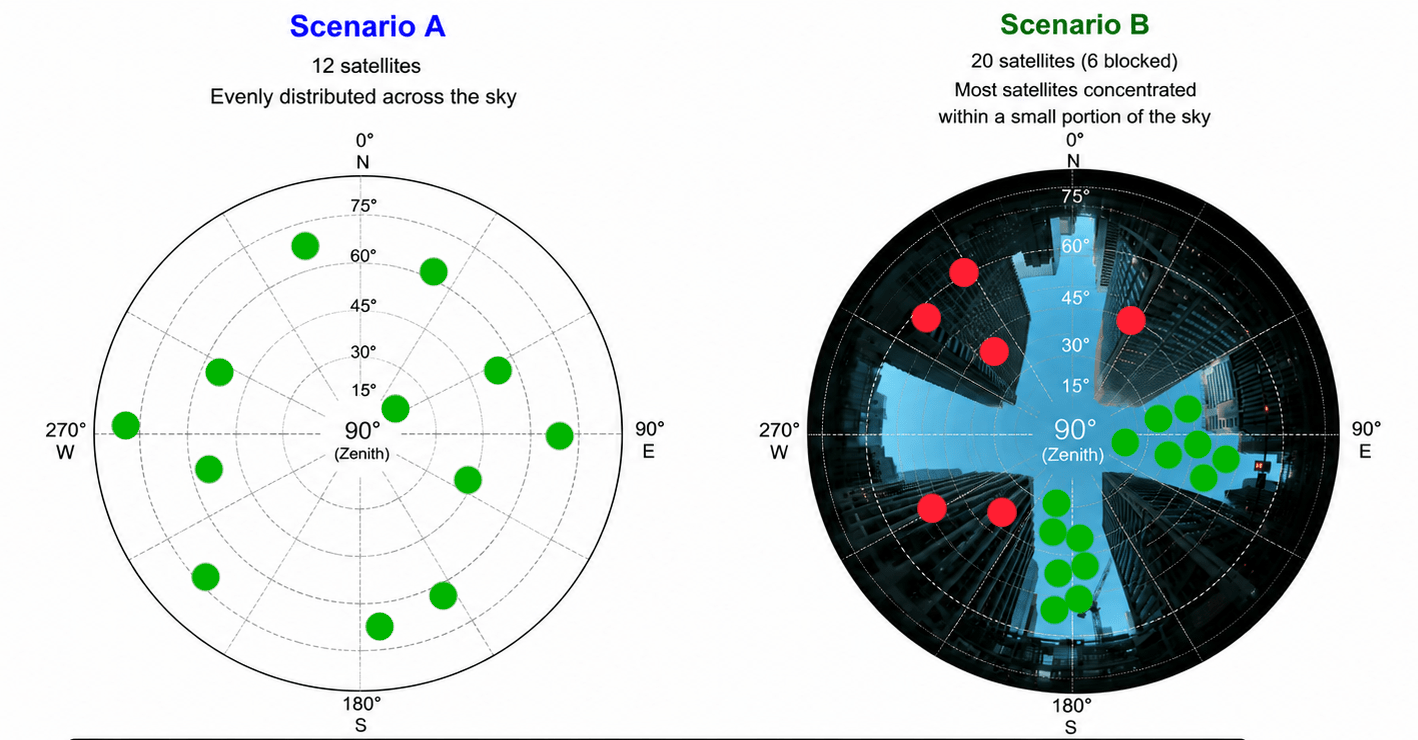
(1) Scenario A
- 12 satellites
- Satellites evenly distributed across the sky
(2) Scenario B
- 20 satellites
- Most satellites concentrated in a small portion of the sky
- 6 satellites blocked by nearby buildings
Although Scenario B tracks more satellites, Scenario A will often produce a more reliable solution because the satellite geometry is significantly stronger. This spatial relationship is quantified by Dilution of Precision (DOP).
| DOP Type | What it represents |
|---|---|
| HDOP | Horizontal geometry |
| VDOP | Vertical geometry |
| PDOP | Position (Combined horizontal and vertical) geometry |
| TDOP | Receiver clock geometry |
| GDOP | Geometric (Combined position and clock) geometry |
In general, lower DOP values indicate stronger satellite geometry and greater resistance to observation noise. Higher DOP values indicate weaker geometry and greater sensitivity to measurement errors.
At first glance, DOP appears to be an excellent indicator of positioning quality. Unfortunately, DOP only describes the geometry of the satellite constellation. It tells nothing about the quality of the raw measurements themselves that are affected by:
- Multipath
- Signal reflections
- Signal blockage
- Cycle slips
- Observation blunders
- Incorrect ambiguity resolution
In Scenario B, some of the blocked satellites may still be tracked through reflected signals. These observations can introduce large errors while still contributing to a seemingly favorable DOP value. For this reason, DOP should be viewed as a geometry indicator rather than a direct measure of positioning accuracy.
RMS Accuracy: Useful but Often Misunderstood
Many GNSS receivers report horizontal and vertical RMS values, for example in AuroraNav’s Anypos APP:
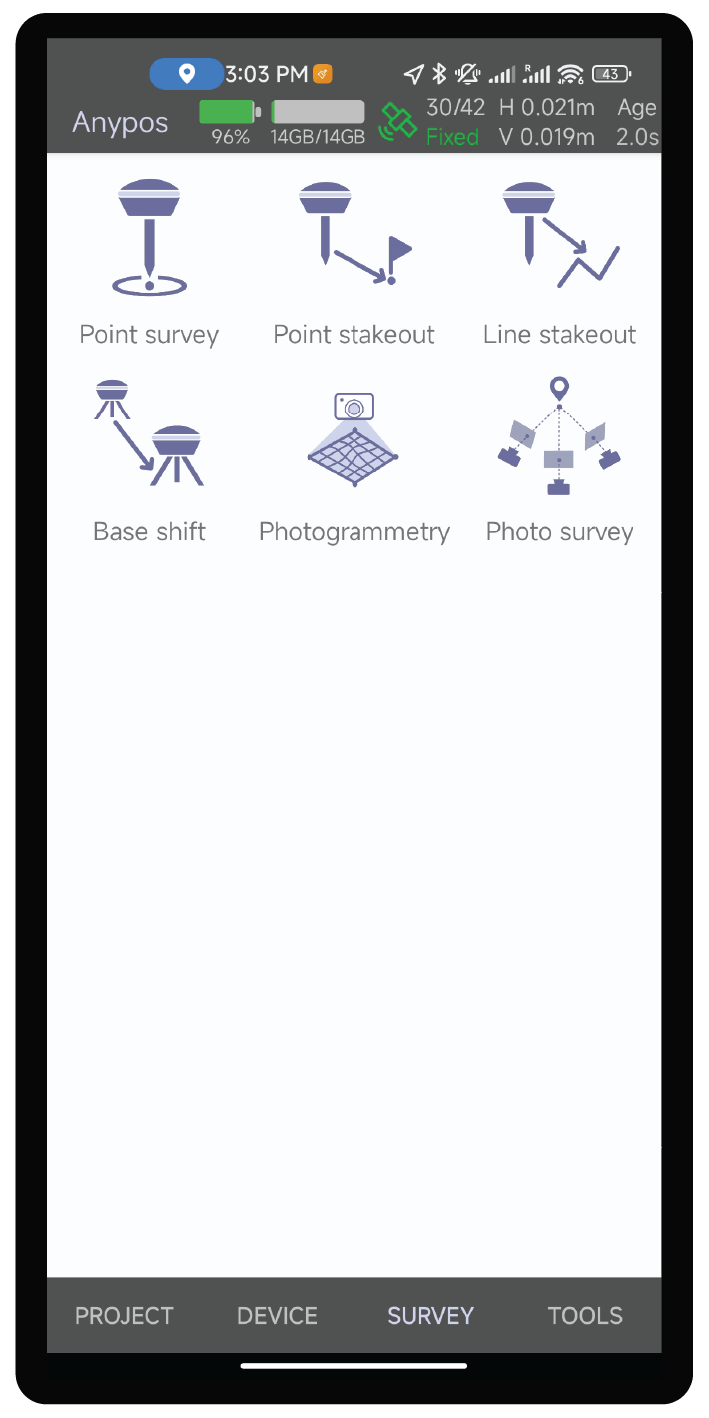
- Horizontal RMS: 0.021 m
- Vertical RMS: 0.019 m
These numbers are often interpreted as actual positioning accuracy. In reality, the reported RMS is usually an uncertainty estimate generated by the receiver’s internal positioning filter, rather than a direct measurement of the true positioning error.
While the detected multipath, blunders, cycle slips are usually identified and excluded from the final RMS calculation, the wrong fix and undetected errors are still not presented in the RMS values. Therefore, the reported RMS fails to serve as a reliable indicator of true positioning error.
This becomes particularly important for FIX solutions. Once integer ambiguities have been fixed, strong constraints are introduced into the positioning model. As a result, the estimated covariance often shrinks dramatically, producing very small RMS values. The receiver may report millimeter-level RMS estimates even when the true positioning error remains significantly larger.
Different manufacturers also implement RMS calculations differently, making direct cross-brand comparisons difficult. Some receivers report very optimistic RMS values, while others are more conservative.
RMS is therefore best viewed as an indication of the receiver’s internal confidence in its own solution, rather than a direct measurement of real-world positioning accuracy.
To bridge this gap, modern high-end RTK receivers often include:
- Integrity monitoring
- Wrong-fix detection
- Observation quality control
AuroraNav’s RTK receivers feature intelligent error-detection engines built precisely to address these hidden vulnerabilities. By filtering out undetected observation anomalies and wrong fixes before they corrupt the solution, our technology drastically minimizes positional drift—ensuring that the reported RMS aligns far more closely with true, real-world accuracy. Explore AuroraNav’s solutions here: AuroraNav full frequency GNSS receivers.
What Should You Actually Look At?
Repeatability: One of the Most Reliable Indicators
The most practical way to evaluate the RTK accuracy is to measure the same point multiple times. A standard field validation workflow looks like this:
- Measure a point.
- Move away from the point.
- Reoccupy the point.
- Repeat the measurement several times.
If all independent measurements agree within a few centimeters, you can be highly confident that your positioning results are genuinely reliable.
Unlike RMS values, repeatability actual, real-world field performance. Repeatability evaluates the entire measurement system rather than a single internal statistic. It inherently captures the combined effects of satellite observations, ambiguity resolution, multipath interference, environmental conditions, and receiver performance.
If a point consistently yields the same coordinates across independent occupations, there is a good chance that the measurement is reliable. Conversely, if the repeated measurements disagree, further investigation is immediately warranted—no matter how optimistic the receiver’s displayed RMS values might appear.
Environmental Conditions Matter
Even the most advanced RTK receiver can struggle in poor environments. Surveyors must exercise extra caution when operating near tall buildings, dense tree canopies, massive metal structures, urban canyons, high-voltage power lines, or large reflective surfaces. These environments severely cause signal blockage and multipath interference, degrading positioning accuracy and heightening the risk of an undetected wrong fix.
Before trusting any RTK measurement, take a moment to evaluate the surroundings.
- Is the sky view sufficiently open?
- Are there reflective surfaces nearby?
- Could the receiver be tracking Non-Line-of-Sight (NLOS) reflections rather than direct, clean signals?
In many cases, environmental awareness provides more useful information than any number displayed on the data collector screen.
Use All Indicators Together
The reality is that no single RTK metric can fully guarantee positioning accuracy.
FIX status merely indicates whether ambiguity resolution has succeeded.
Satellite count & DOP values only provide information about constellation geometry.
RMS values describe the receiver’s internal confidence in its solution. Environmental conditions influence the quality of the underlying observations. Repeatability evaluates whether the entire measurement process produces consistent results.
Each metric provides a different piece of information, and each has limitations when viewed in isolation.
The most reliable approach is therefore to consider all available evidence together. When a measurement has a FIX solution, reasonable DOP values, low RMS estimates, clean satellite visibility, and consistent repeatability, you achieve the highest possible confidence in your field data. Conversely, When these indicators disagree, additional verification is necessary.
Professional surveyors rarely stake their reputation on a single number. Instead, they build confidence by evaluating multiple indicators simultaneously.
Summary
FIX status, satellite count, DOP values, and RMS estimates all provide useful insights, but no single metric alone can guarantee RTK accuracy.
The absolute best practice to ensure data integrity is to check multiple indicators, including solution status, satellite geometry, RMS estimates, environmental conditions, and repeatability checks. A good surveyor does not rely on a single metric. Instead, they evaluate all available evidence before deciding whether a position can be trusted.
If a measurement is important and there is any doubt about its quality, the best practice is simple: measure the point again.
If you are evaluating RTK equipment for surveying, mapping, GIS, drone operations, or precision agriculture, choosing the right hardware is just as important as understanding the quality indicators it reports.
Explore Aurora Navigation’s full-frequency GNSS receivers to see how modern RTK technology and professional-grade positioning performance can safeguard your next project: AuroraNav full-frequency GNSS receivers.