
For years, Real-Time Kinematic (RTK) has been a fundamental technology in surveying, drone mapping, construction, precision agriculture, and robotics. While standard GNSS positioning typically provides meter-level accuracy, RTK dramatically improves this to centimeter-level accuracy in real time by using carrier-phase measurements and differential observations from a nearby reference station.
But how exactly does it work?
This article explains the core ideas behind RTK, from satellite signals all the way to centimeter-level positioning.
What Is RTK GNSS
RTK is a positioning technique that improves GNSS accuracy from meters to centimeters by using carrier-phase measurements and corrections from a nearby base station.
Why Standard GNSS Is Only Accurate to a Few Meters
A standalone GNSS receiver determines its position by simultaneously measuring the distances to multiple satellites, derived from the signal travel time (code measurements).
With signals from at least four satellites, the receiver can compute its position (x,y,z) and clock offset (t) by solving a system of multiple equations with four unknowns.
In practice, however, several major error sources affect these measurements:
- Satellite clock errors
- Satellite orbit uncertainties
- Ionospheric delay
- Tropospheric delay
- Multipath reflections
- Observation noise
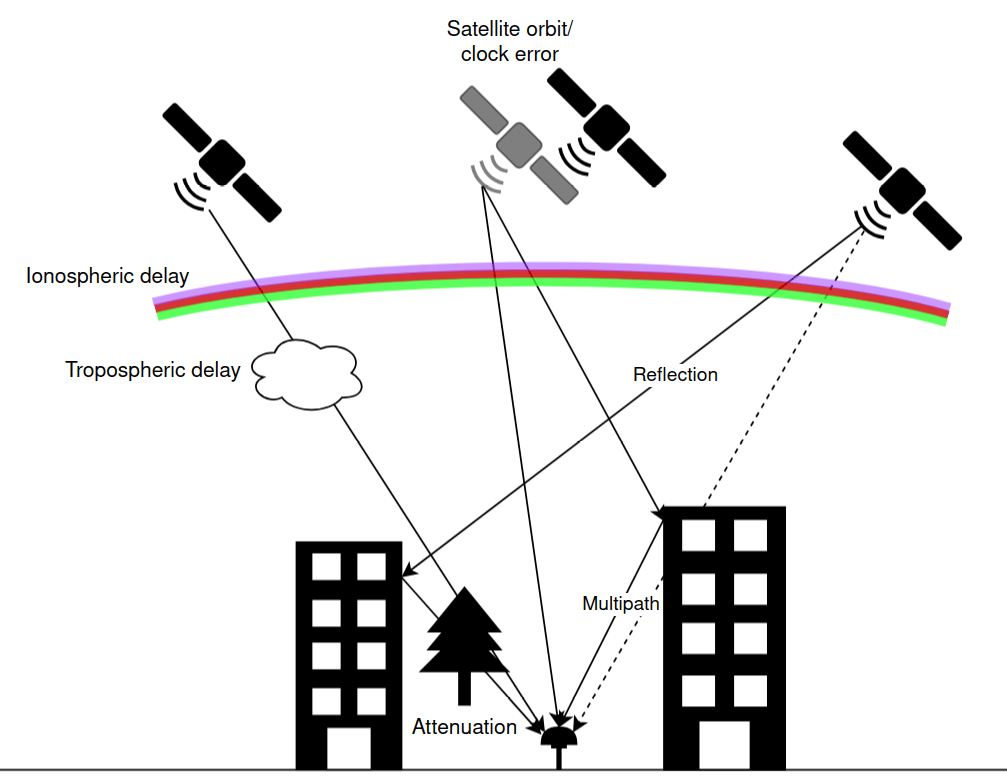
Even with modern multi-constellation GNSS systems (GPS, Galileo, GLONASS, BeiDou), these errors typically limit standalone positioning (also known as SPP solutions) accuracy to about 2–5 meters.
RTK improves accuracy by allowing two receivers to simultaneously observe the same satellites and compare their measurements.
How RTK GNSS Works
An RTK system typically consists of two receivers:
Base Station
- Has a known coordinate
- Continuously tracks GNSS satellites
- Performs quality checks and transmits raw GNSS observations and station coordinates to the rover
Rover
- The mobile GNSS receiver
- Receives satellite signals and observation data from the base station
- Combines both datasets to compute differential positioning and determine its precise location
In a practical RTK work, the base station and rover are implemented with dedicated GNSS receivers with high end antenna, chips, and algorithms. For example, AuroraNav G1000 can serve as a survey-grade RTK base station or rover, while the AuroraNav Astra1 enables compact professional rover setups using a smartphone.
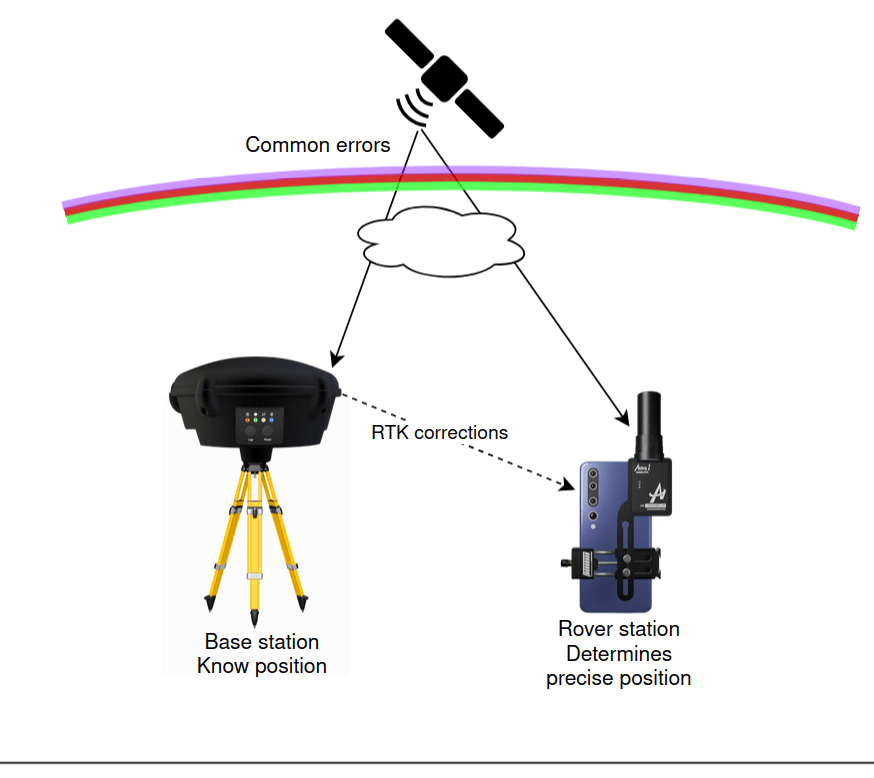
It should be noted that, in CORS network RTK using VRS mode, the base station can also be set up virtually. In this case, the base station still effectively exists, but its observations are synthesized from multiple physical reference stations.
The rover and base station share the same satellite orbit and clock errors. Additionally, because the base station and rover are usually located within a few to tens of kilometers of each other, they experience nearly the same ionospheric and tropospheric delays.
By comparing the measurements from both receivers, many of these common errors can be effectively eliminated.
Correction data is typically transmitted via:
- Radio links
- Cellular networks (NTRIP or TCP)
Is that enough? No. Multipath errors and observation noise still remain. For code measurements, these errors can still be significant, ranging from decimeters to several meters. Positioning solutions derived from differential code observations are known as RTD (Real-Time Differential) solutions, which typically achieve decimeter-level accuracy at best.
The Key Idea: Carrier-Phase Measurements
RTK achieves centimeter accuracy by using a much more precise observable: the carrier-phase of GNSS signals.
GNSS signals are radio waves with wavelengths on the order of tens of centimeters. For example:
- GPS L1 wavelength: ~19.0 cm
- GPS L2 wavelength: ~24.4 cm
- GPS L5 wavelength: ~25.5 cm
By tracking the phase of the carrier wave, a GNSS receiver can measure changes in the satellite-receiver distance with millimeter-level precision. However, there is a challenge: while the receiver can measure the accumulated change of phase of the signal (known fraction part), it does not initially know how many full wavelengths exist between the satellite and the receiver. Which is called the integer ambiguity.
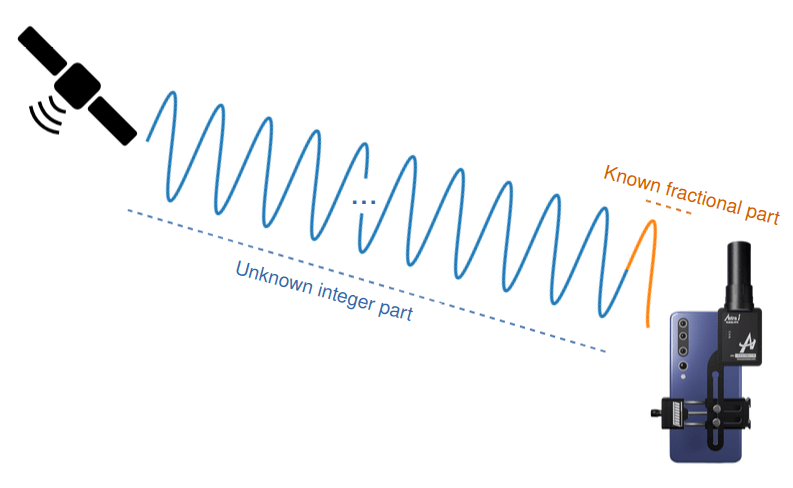
The Hardest Problem: Integer Ambiguity Resolution
Resolving the integer ambiguity is the key step that allows RTK to achieve centimeter accuracy.
RTK algorithms combine the differential code measurements (decimeter-level accuracy) with the carrier-phase observations in a single estimation process. Initially, the integer ambiguities are treated as floating-point values and are gradually refined as more measurements are collected. As the solution converges and the uncertainty decreases, the algorithm leverages the fact that these parameters must be integers and searches for the most likely integer combination.
Once the correct integer values are determined, the carrier-phase measurements can be used to compute extremely precise satellite-receiver distances and coordinates. The system now achieves a fixed solution. This process is called ambiguity resolution.
Modern RTK receivers, such as AuroraNav G1000 and AuroraNav Astra1, track multiple carrier frequencies simultaneously to improve ambiguity resolution and positioning reliability.
RTK Accuracy
RTK receivers typically report several positioning solution states:
| Solution Type | Description | Typical Accuracy |
|---|---|---|
| SPP (Standard Positioning) | No differential corrections are applied | Meter-level |
| DGPS | Differential code measurements are applied | Sub-meter to meters |
| RTK Float | Integer ambiguities are not yet fixed | Decimeter-level |
| RTK Fixed | Integer ambiguities are resolved | Centimeter-level |
In good conditions, modern RTK receivers can achieve a fixed solution within seconds.
Limitations of RTK
Although RTK can provide centimeter accuracy, real-world environments can make positioning more difficult. Common challenges include:
Multipath
Signals reflected from buildings, vehicles, or nearby structures can distort measurements.
Signal obstruction
Trees, buildings, or terrain may block satellite signals.
Poor satellite geometry
When satellites are clustered in similar directions in the sky, positioning accuracy decreases.
Long baselines
If the rover is too far from the base station, atmospheric errors between the two receivers become less correlated.
Conclusion
RTK enables real-time centimeter-level positioning by combining three key ideas:
- Differential observations from a nearby base station
- Carrier-phase measurements with millimeter precision
- Integer ambiguity resolution
In practice, this means you can achieve survey-grade accuracy within seconds. However, real-world performance depends heavily on hardware quality, signal tracking capability, and system design.
Modern full-frequency GNSS receivers can significantly improve:
- Fix rate and time-to-fix
- Stability in challenging environments
- Performance under partial signal obstruction
For example, receivers like AuroraNav G1000 (survey-grade base/rover) and AuroraNav Astra1 (compact mobile RTK) are designed to deliver reliable centimeter-level positioning across surveying, drone mapping, and robotics workflows.
If you’re evaluating RTK solutions for your project, choosing the right hardware is critical. Explore our RTK GNSS solutions here: AuroraNav full frequency GNSS receivers.