
Real-Time Kinematic (RTK) and Precise Point Positioning (PPP) are two of the most widely used techniques in high-precision GNSS. At first glance, both can deliver centimeter-level accuracy.
What is exactly the difference between them? When should you choose RTK and when to PPP in your real-world project? In this article, we break down:
- The key differences between RTK vs PPP positioning
- How each method handles GNSS error sources
- A comparison of convergence time, accuracy, and infrastructure requirements
- Practical applications of PPP and RTK in real projects
- When to use RTK, PPP, or a hybrid approach
RTK vs PPP Comparison Overview
| Feature | PPP | RTK |
|---|---|---|
| Base station required | No | Yes |
| Setup complexity | Low | Medium |
| Convergence time | 10–40 min | Instant |
| Accuracy | 1-2cm (fixed)/ 2–5 cm(float, after convergence) | 1–2 cm |
| Coverage | Global | Local |
The figure below shows a typical convergence behavior of PPP vs RTK in ideal environments.
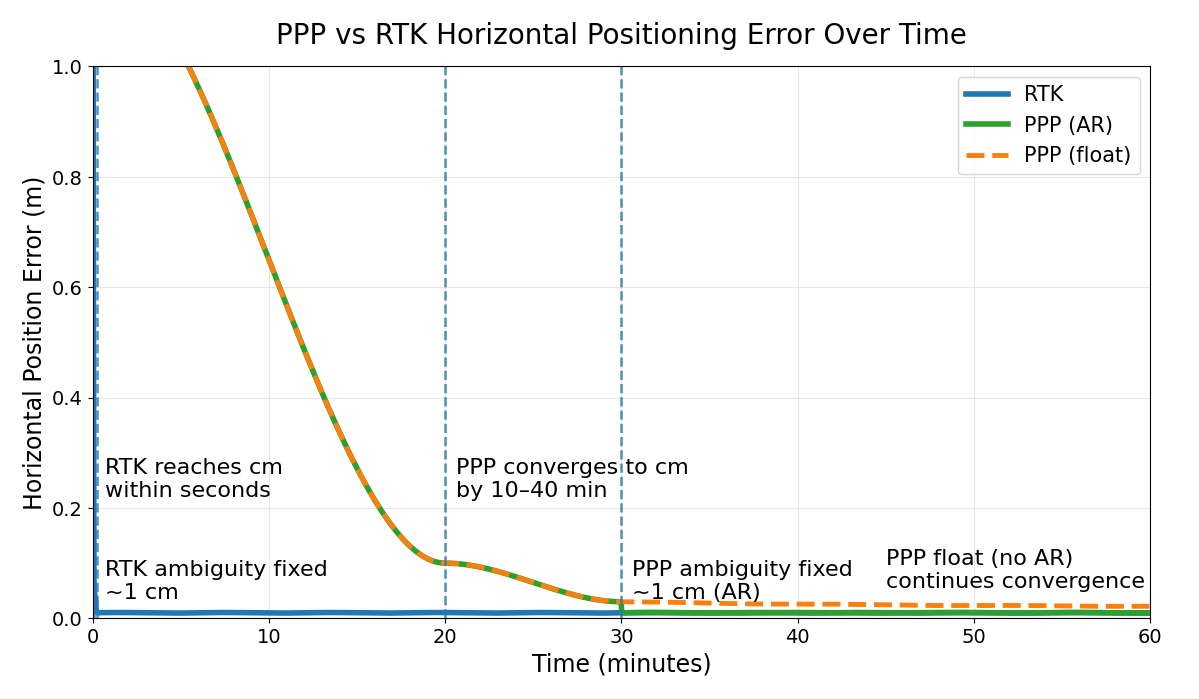
RTK reaches centimeter-level accuracy within seconds. While PPP gradually improves over time and, when ambiguity resolution is applied (PPP-AR), can achieve similar accuracy after convergence.
Note: This is an illustrative example. Actual performance depends on environment, signal quality, and correction sources.
This difference is the key reason why RTK is preferred for real-time applications, while PPP is used for global or infrastructure-free scenarios.
In short: PPP is ideal for global high‑accuracy positioning without local infrastructure, while RTK is preferred for instant centimeter positioning. In many real-world workflows, the best solution is to use both.
How PPP and RTK Actually Works comparison
PPP is a GNSS positioning technique that allows a single receiver to achieve centimeter-level accuracy without a base station. Instead of cancelling errors locally, PPP relies on precise satellite orbit, clock, and bias corrections, along with estimation of atmospheric effects.
This is why PPP requires a convergence period before reaching high accuracy.
More details on PPP can be found in PPP-GNSS-Explained.
RTK, on the other hand, works by comparing measurements between a base station (known position) and a rover (unknown position). Because both receivers observe nearly identical errors over a short baseline, these errors are mostly directly cancelled.
This enables instant ambiguity resolution and real-time centimeter-level accuracy.
Detailed explanation of RTK is available in RTK-GNSS-Explained.
To be brief, they differs mainly in the way to deal with error sources:
| Error source | PPP | RTK |
|---|---|---|
| Satellite orbit/clock | Corrected using precise products | Mostly cancelled using base station |
| Phase bias | Corrected (PPP-fixed) / ignored (PPP-float) | Mostly cancelled using base station |
| Ionospheric delay | Eliminated (multi-frequency) or estimated | Mostly cancelled using base station |
| Tropospheric delay | Estimated | Mostly cancelled using base station |
RTK vs PPP Applications Comparison
When should you use each:
| RTK | PPP |
|---|---|
| – Need instant centimeter accuracy – Surveying / staking / layout – Local project sites – Base station available |
– No access to a base station – Large or remote areas – Can tolerate convergence time – Require global consistency |
Typical use cases:
| RTK | PPP |
|---|---|
| – Land surveying – Construction layout – GCP collection – UAV mapping |
– Offshore positioning – Long-duration monitoring – Reference station initialization – Remote scientific measurements |
Mordern receivers like AuroraNav G1000 (survey-grade base/rover) and AuroraNav Astra1 (compact mobile RTK) are designed to deliver reliable centimeter-level positioning across surveying, drone mapping, and robotics workflows, whether you are seeking for a PPP, RTK or combined solutions.
RTK + PPP: The Hybrid Approach
RTK and PPP can be combined to achieve both absolution positioning consistency and efficiency with modern survey-grade devices like AuroraNav G1000 and AuroraNav Astra1.
Base + Rover Workflow
- Use PPP to determine base station coordinates (real-time or post-processed)
- Use RTK for real-time rover positioning
This ensures absolute positioning consistency + instant availability. If PPP is performed in post-processing way, the captured RTK coordinates can also be corrected afterwards.
PPP as Backup
- Use RTK when base station link is available
- Fall back to PPP when base link is lost
This hybrid strategy is increasingly common in modern GNSS systems.
RTK vs PPP FAQs
(1) Why does PPP take so long to converge?
PPP needs time to estimate atmospheric errors and resolve carrier phase ambiguities.
(2) Can PPP replace RTK?
Not entirely. PPP is better for global coverage, while RTK is better for real-time applications.
(3) Can I use both PPP and RTK together?
Yes, modern GNSS workflows often combine both for better reliability and flexibility.
(4) Can PPP achieve the same accuracy as RTK?
Yes, with ambiguity resolution (PPP-AR), PPP can achieve similar centimeter-level accuracy as RTK after convergence. However, convergence time and reliability depend on correction services and environment.
Conclusion
RTK and PPP are not competitors, they solve different problems.
- RTK provides instant centimeter-level accuracy using a nearby base station
- PPP provides global positioning without infrastructure but requires convergence time
- RTK is ideal for real-time applications
- PPP is ideal for remote or large-scale projects
Understanding this difference is key to building efficient real-world GNSS workflows.
If your workflow requires both flexibility and accuracy, choosing a GNSS system that supports RTK, PPP, and hybrid positioning can significantly improve efficiency. Learn more about how our AuroraNav GNSS Solutions enable real-world positioning workflows.