
Global Navigation Satellite Systems (GNSS) have become essential in surveying, mapping, agriculture, construction, and navigation. Performances of GNSS receivers can vary a great deal. One of the biggest deciding factors for positioning performance is whether a receiver supports single-frequency, dual-frequency or multi-frequency GNSS.
So, how exactly does multi-frequency GNSS improve accuracy?
In this article, we will break down:
- What multi-frequency GNSS actually means and how modern satellite signals are structured
- How multiple frequencies improve ionospheric error correction and long-baseline accuracy
- Why multi-frequency receivers achieve faster convergence and more reliable RTK/PPP solutions
- How modernized signals help reduce multipath impact under trees and near buildings
- Why multi-frequency GNSS has become essential for professional surveying, mapping, and precision positioning workflows
What Is Multi-Frequency GNSS?
Modern GNSS satellites from major constellations transmit signals on multiple frequencies.
| Constellation | Signal | Frequency (MHz) |
|---|---|---|
| GPS | L1C/A L1C L2C L2P L5 |
1575.42 1227.6 1176.45 |
| GLONASS | L1C/A L2C L2P L3OC |
1598.0625-1609.3125 1242.9375-1251.6875 1202.025 |
| Galileo | E1 E5a E5b E5 AltBOC E6 |
1575.42 1176.45 1207.14 1191.795 1278.75 |
| BeiDou | B1I B2I (obsolete) B3I B1C B2a B2b |
1561.098 1207.14 1268.52 1575.42 1176.45 1207.14 |
| QZSS | L1C/A L1C L1S L2 C L5 L6 |
1575.42 1227.6 1176.45 1278.75 |
| IRNSS | L5 | 1176.45 |
| SBAS | L1 L5 |
1575.42 1176.45 |
Not all dual-frequency or multi-frequency receivers support the same signal bands. The comparison below illustrates why specifications matter.
| GNSS receivers | Channels | Supported bands |
|---|---|---|
| Receiver A | 184 | GPS: L1C/A, L2C GLONASS: L1, L2 Galileo: E1, E5b BeiDou: B1I, B2I QZSS: L1C/A, L2C |
| Receiver B | 672 | GPS: L1C/A, L2C, L5 GLONASS: L1, L2 Galileo: E1, E5a, E6 BeiDou: B1I, B1C, B2a, B3I QZSS: L1C/A, L1C, L2C, L5 IRNSS: L5 |
| AuroraNav G1000 | 1408 | GPS: L1C/A, L1C, L2C, L2P(Y), L5 GLONASS: L1, L2, L3 Galileo: E1, E5a, E5b, E6 Beidou: B1I, B2I, B3I, B1C, B2a, B2b QZSS: L1C/A, L1C, L2C, L5, L6 IRNSS: L5 SBAS: L1C/A |
| AuroraNav Astra1 | 1408 | GPS: L1C/A, L2C, L2P, L5 GLONASS: L1, L2 Galileo: E1, E5a, E5b, E6 Beidou: B1I, B2I, B3I, B1C, B2a, B2b QZSS: L1, L2, L5 SBAS: L1C/A |
As the modernization of the BeiDou system continues, B2I is no longer available on most BDS-3 satellites. This means some older dual-frequency receivers that rely on B1I + B2I effectively lose one of their primary BeiDou frequencies on newer satellites. Likewise, GPS L5 is not yet available on every GPS satellite as of 2026.
How Multi-Frequency GNSS Reduces Ionospheric Errors
The ionosphere is one of the largest natural error sources in GNSS positioning. Uncorrected part of ionospheric delay can easily reach 5–15 meters, depending on satellite elevation and solar activity. However, different frequencies experience different ionospheric delays, while many other error sources remain nearly the same. This makes multi-frequency observations extremely valuable..
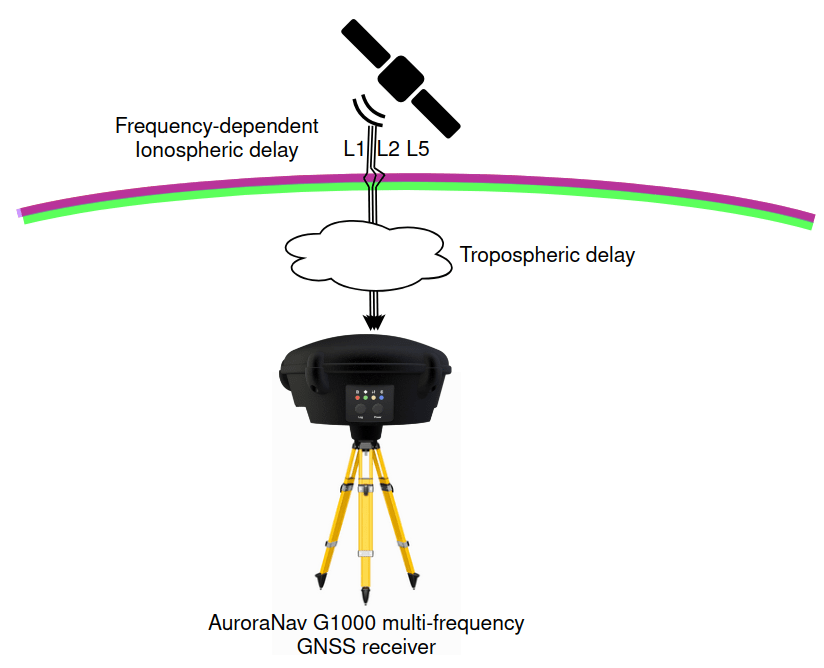
The ionospheric delay can either be directly estimated or simply eliminated (mostly but not fully) by generating ionospheric-free observations with the data from different frequencies. This lead to the biggest advantages of multi-frequency GNSS: the ability to reduce ionospheric delay.
This is especially important for PPP and long baseline RTK, as the assumption of cancling out ionospheric delay from that of a base station only holds true when, a rover station is close to the base station.
Single-frequency receivers must rely more on low-accuracy broadcast models or external corrections. In general, multiple frequencies provide stronger and more stable ionospheric mitigation than dual frequencies.
Why Multi-Frequency GNSS Converges Faster in RTK and PPP
RTK and PPP relies on resolving the carrier phase ambiguities (see how RTK works and how PPP works). Convergence speed depends heavily on how quickly these ambiguities can be estimated precisely.
Multi-frequency observations help the GNSS engines resolve ambiguities faster with better reliability because the receiver has more independent measurements to work with.
Multi-frequency observations help GNSS engines converge faster because they provide:
- More independent measurements
- Improved redundancy
- Better resistance to poor observations
More Robust Ambiguity Resolution
Carrier-phase ambiguity resolution is at the heart of high-precision GNSS. Carrier phase is extremely precise, but the receiver must determine the correct integer number of whole cycles. Wrong ambiguity fix could lead to positioning error over 20cm without notifying the users.
Multi-frequency observations can be combined to create signals with longer effective wavelengths. Examples include:
- Wide-lane (L1-L2): ~86 cm
- Extra-wide-lane combinations: ~1465 cm
Longer effective wavelengths make ambiguity resolution easier and more reliable. This improves both initialization speed and reliability in real-world applications.
Better GNSS Accuracy Near Trees and Buildings
Many low-cost GNSS receivers can perform reasonably well in open sky. The real challenge comes in environments such as:
- Urban areas with reflected signals
- Work sites near buildings
- Roads with partial sky blockage
- Forests or tree canopies
First, multi-path errors are also frequencies related. Mordern receivers like AuroraNav G1000 (survey-grade base/rover) and AuroraNav Astra1 (compact mobile RTK) use advanced multipath mitigation algorithms which take advantage of multiple frequencies to better identify and suppress reflected signals..
Another benifit is that GNSS modernization has introduced signals with higher chip rates and more advanced modulation formats, such as GPS L5. These modern signals are generally more resistant to multipath and tracking errors than older legacy signals.
That is why multi-frequency receivers are now widely preferred in professional surveying and mapping over older single-frequency or basic dual-frequency designs.
Conclusions
Multi-frequency capability gives a GNSS system a much stronger technical foundation. The benefits are not just theoretical, they translate directly into real-world productivity::
- Less waiting for accurate results
- Fewer re-surveys
- More reliable fixes near obstructions
- Greater confidence in measurements
For surveyors, mappers, drone operators, and precision agriculture users, these advantages can significantly improve project efficiency and data quality.
Need a modern multi-frequency GNSS receiver for surveying, mapping, drone control points, or RTK fieldwork? Explore AuroraNav GNSS Solutions built for professional positioning performance.