
Precise Point Positioning (PPP) is a GNSS positioning technique that allows a single receiver to achieve centimeter-level accuracy without a base station.
- But how does PPP actually work?
- Why does it take 10–40 minutes to converge?
- And what is the realistic accuracy that PPP can achieve?
In this guide, we break it down in plain language.
What is Precise Point Positioning (PPP)
- PPP uses global satellite corrections instead of a local base station
- It can achieve centimeter-level accuracy globally
- It requires 10–40 minutes to converge
- Multi-frequency GNSS is critical
- Accuracy is comparable to RTK after convergence
PPP is extremely useful for:
- Control point survey
- Deformation monitoring
- Remote surveying
- Marine positioning/ offshore survey
- Geodesy
- Scientific GNSS analysis
Why GNSS Has 5–10 Meter Errors (and How PPP Fixes Them)
Standard GNSS positioning is affected by multiple error sources that degrade accuracy:
- Satellite orbit uncertainties
- Satellite clock errors
- Ionospheric delay
- Tropospheric delay
- Multipath reflections
- Receiver noise
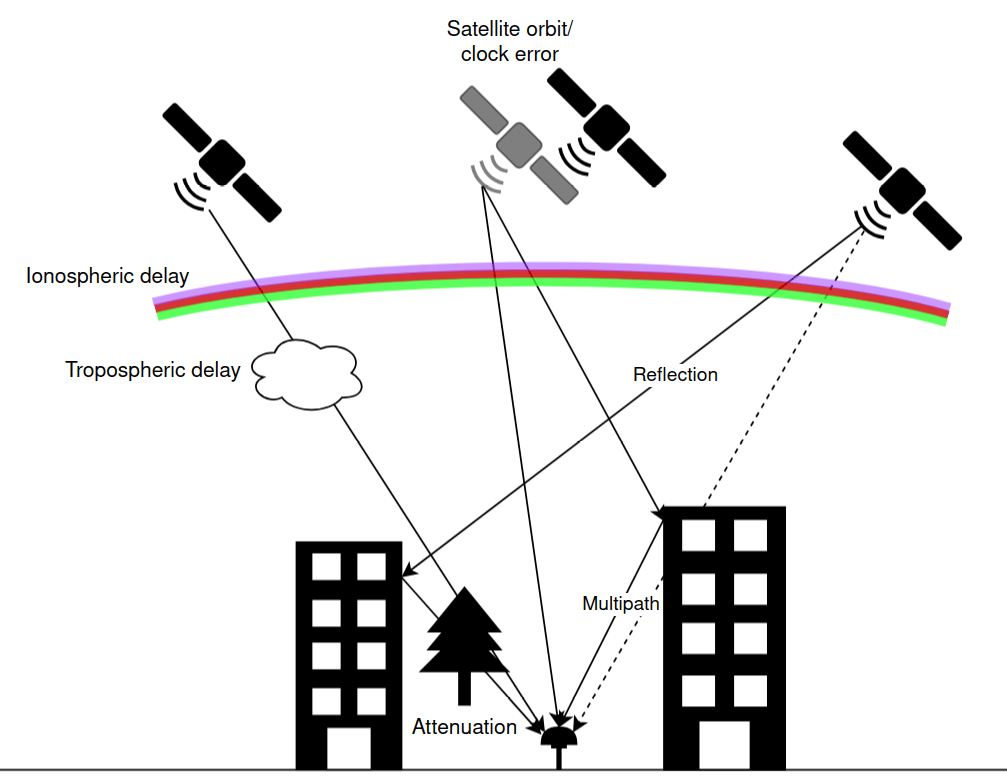
Without corrections, these errors stack up to 5–10 meter GNSS accuracy.
Satellite Orbit and Clock Uncertainties
Instead of using broadcast data (meter-level error), PPP uses corrections from global networks like IGS:
- Orbit accuracy: < 5 cm
- Clock accuracy: ~3 cm
Recently, BeiDou B2b and Galileo HAS are starting to offer free satellite orbits and clock corrections through satellites. But the service coverage is still limited to Europe and Asia as of 2026.
The Biggest Problem: Ionospheric Delay
The ionosphere is the largest error source in GNSS. Ionospheric errors can reach 5–15 meters.
Here’s the trick: Different frequencies experience different ionospheric delays
So if your receiver tracks multiple frequencies, you can cancel the ionosphere. This is called the ionosphere-free combination.
| Frequency | Accuracy |
|---|---|
| Single-frequency | Meters without corrections |
| Dual-frequency | Centimeters |
| Multiple-frequency | Centimeters with best performance |
Most dual-frequency GNSS receivers, such as Emlid RS3, lack the second frequency support for GLONASS and BDS3 new satellites. This is why modern high-end GNSS receivers focus heavily on full-frequency tracking. For example, devices like like AuroraNav G1000 and AuroraNav Astra1 track multiple constellations and frequencies simultaneously, which directly improves PPP convergence speed and stability.
Tropospheric Delay
Tropospheric delay cannot be eliminated like ionosphere, but it can be accurately estimated during PPP processing.
In practice, this means tropospheric error is not a limiting factor for PPP accuracy.
Multipath
Signals reflected from buildings, terrain, or surfaces can create measurement errors.
Typical magnitude:
Centimeters to meters for code observations, and centimeters for carrier phase observations. A good site environments is important for satisfactory PPP accuracy.
Receiver Noise
Receiver electronics and antenna characteristics introduce small measurement noise.
The typical magnitude depends on the receiver characteristics, a high-end GNSS receivers such as AuroraNav G1000 and AuroraNav Astra1 offers 10cm noise for code observations, and 1mm for carrier phase observations. While typical values for a consumer level cellphone GNSS is tens of meters for code observations.
The receiver noise is often the least noticeble terms for high-end receivers like AuroraNav G1000 and AuroraNav Astra1.
Carrier Phase Observations and ambiguity resolution
Like RTK, PPP also relies on carrier phase measurements for precise positioning, but without knowing the integer ambiguity (learn what is integer ambiguity)
After applying phase bias corrections from global networks, the ambiguities become integer in nature. Just as RTK does, PPP algorithms combine the corrected code measurements (decimeter-level accuracy) with the carrier-phase observations in a single estimation process. Initially, the integer ambiguities are treated as floating-point values and are gradually refined as more measurements are collected. As the solution converges and the uncertainty decreases, the algorithm leverages the fact that these parameters must be integers and searches for the most likely integer combination.
Once the correct integer values are determined, the carrier-phase measurements can be used to compute extremely precise satellite-receiver distances and coordinates. The system now achieves a fixed solution. This process is called ambiguity resolution.
Why PPP Takes 10–40 Minutes to Converge
PPP solutions improve as carrier phase ambiguities converge.
Typical convergence time: 10–40 minutes
If signals are interrupted due to obstruction, receiver upside down or cycle slip, another convergence time would be required for PPP re-convergence for the affected satellites.
How Accurate is Precise Point Positioning
PPP solution accuracy depends on observation time, receiver quality, and satellite visibility. Typical Expectations for high-end GNSS receivers:
| Method | Accuracy |
|---|---|
| Float Single frequency PPP | 0.3–1 m |
| Float PPP | 2–5 cm |
| Fixed PPP | RTK comparable |
PPP can reach RTK-level accuracy although not instantly.
Conclusion
Precise Point Positioning is a powerful GNSS technique that enables centimeter‑level positioning anywhere on Earth.
If you’re looking for faster PPP convergence and more reliable centimeter-level positioning, hardware makes a critical difference.
Modern full-frequency GNSS receivers significantly improve PPP performance in real-world environments.
Explore AuroraNav full-frequency GNSS receivers here: AuroraNav full frequency GNSS receivers.